
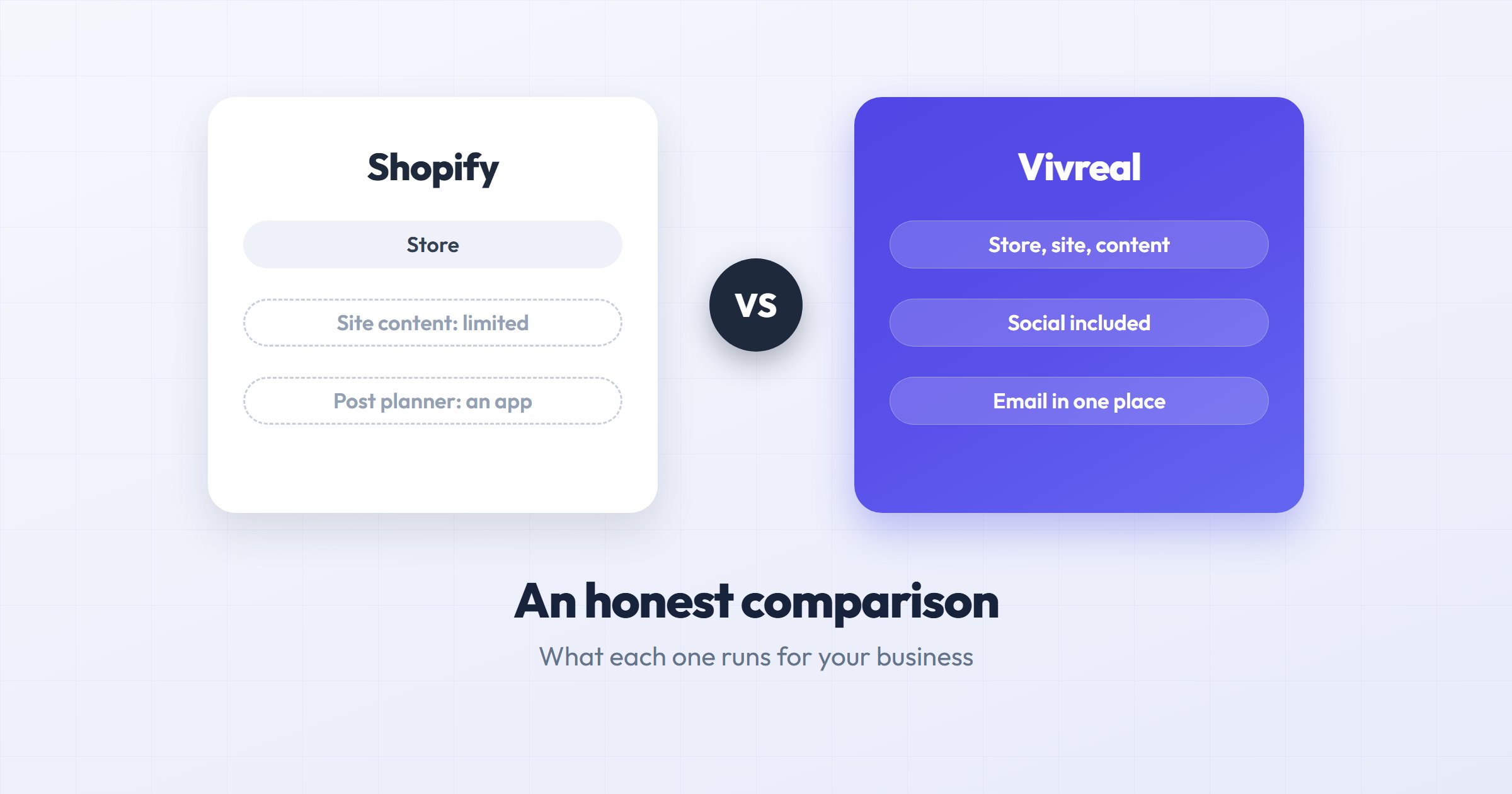
If selling products online is the whole business, Shopify is hard to beat and this comparison is easy: stay on Shopify. It gets interesting when the store is only part of what you do. Most owners also have a site to keep current, a story to tell, posts to write, and a list to email. Shopify covers the store and the email well, but the site content and the social posting end up spread across apps and other tools. Vivreal runs all of it from one place, with a store connected to Stripe or Square, and one Publish that updates your site and your posts together.
Start free, no credit card. Setup in about two minutes.
Here's the honest side-by-side:
| Shopify | Vivreal | |
|---|---|---|
| Selling products | Best in class checkout, huge app store | A store connected to Stripe or Square, products managed with the rest of your content |
| Site and content | Storefront plus a basic blog | A full site, with the kinds of content your business actually has |
| Social posts | Sells through social channels, but no built-in planner; most stores add an app | Built in, schedule ahead, one publish reaches every connected channel |
| Built in, 10,000 sends a month, then $1 per 1,000 | Connect Mailchimp and write, schedule, and send campaigns from Vivreal, with opens and clicks reported back | |
| Editing your site | Theme editor, then check the live site | Edit and watch the page take shape, built with the same design your live site uses |
| Run it from your phone | Mobile app for the store | The whole portal works from your phone or tablet, installs like an app |
| Price | $39 to $399 a month monthly, less billed annually, plus apps | Free to start, paid plans $19 to $119, everything included |
What Shopify genuinely does well
Shopify is the best pure store on the market and it isn't particularly close. Checkout converts, payments and taxes and shipping are handled, the app store covers every edge case, and it scales from a first sale to an enormous catalog without you rethinking anything. Shopify Email being included, with 10,000 free sends a month, is genuinely generous. If you're moving real volume in products, that machine is worth paying for.
So this isn't a "switch away from Shopify" article. It's about the owners for whom the store is one part of a business, not the whole thing: the bakery that sells a few things online but lives on its menu and its Instagram, the studio with a shop page and a schedule, the shop whose website has to do more than list products.
Gap one: your website is more than a storefront
Shopify's job is the store, and everything else is built around that shape. The blog is basic. Pages outside the store are limited compared to what a real site needs. If your business has things that aren't products (a menu, a class schedule, a portfolio, locations, staff, events), you end up bending the store to hold them or bolting on an app.
Vivreal starts from the content side. You define the kinds of content your business actually has, products included, and your site is built from that. The store is one type of content among the others, connected to Stripe or Square for payments, and it sits alongside everything else you publish rather than defining the shape of the site.
Gap two: the posting is still on you
Shopify will sell through social channels and keep a product catalog in sync, which is useful. What it doesn't do is plan and schedule the posts themselves. There's no built-in planner, so most stores add a third-party scheduling app, which means another login, another bill, and another place to write the same words you already wrote on the product page.
In Vivreal the post and the page come from the same content. New product, new special, new event: write it once, and the page on your site and the post for each connected channel are both built from it. One Publish sends them together, on the schedule you set. Nothing goes out of sync, because there is nothing to sync.
Email sits in the same place, with one honest difference worth naming. You connect your Mailchimp account, then write, schedule, and send campaigns from inside Vivreal using the audiences you already have, and the opens and clicks come back next to the rest of your numbers. Your list stays yours in Mailchimp.
There's a quieter difference too. More customers now ask an AI assistant for a recommendation instead of scrolling search results. Every Vivreal site ships in a format those assistants can read, so your business can be the answer. You don't set anything up. It comes with the site.
What switching actually looks like
I sell a lot of products. Should I move?
Probably not, and we'd rather say so. If your volume and your catalog are the business, Shopify's checkout and app ecosystem are worth the bill. Vivreal is the better fit when the store is one part of a business that also has a site, content, and marketing to run.
Can I keep my domain?
Yes. Your domain moves with you, same address, no interruption for your customers.
How do payments work?
Your store connects to Stripe or Square, so payouts, cards, and receipts work the way you'd expect, and you manage the products in the same place as the rest of your content.
What happens to my apps?
Add up your plan plus the scheduling app plus anything else you pay monthly to fill the gaps. For most small stores that becomes one bill.
The bottom line
If your business is the store, Shopify is the right tool and you should keep it. If your store is one part of a business that also has a website to keep current, posts to write, and a list to email, running all of it from one place is a different kind of relief. That's what Vivreal is for.